




THE COMPLETE BUYER'S GUIDE TO MARBLE CHESS SETS
THE COMPLETE BUYER'S GUIDE TO
MARBLE CHESS SETS
How They're Made · Color Options · What to Look For · Care & Maintenance
There is something deeply satisfying about playing chess on stone. The cool weight of a marble piece in your hand, the subtle click as it meets the board, the visual drama of veined stone under warm light — a marble chess set is not just a game. It is a statement, a keepsake, and for many players, the most beautiful object in the room.
Whether you are a seasoned tournament player looking for a display centrepiece, a design-conscious homeowner wanting something spectacular on the coffee table, or shopping for a gift that will be treasured for decades, this marble chess set buying guide covers everything you need to know before you buy. We will walk you through how marble chess sets are made, the key differences between stone types, every major colour option available today, what size to choose, and how to care for your investment.
1. What Is a Marble Chess Set?
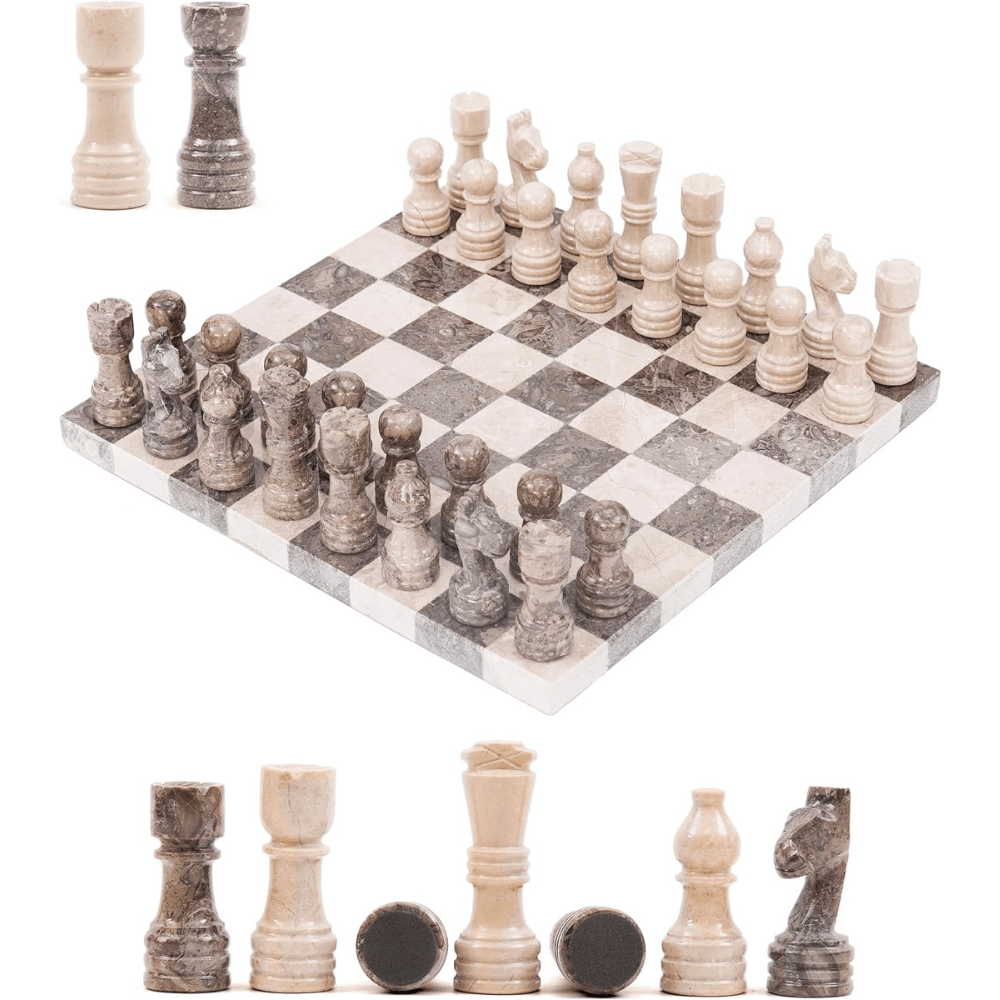
A marble chess set consists of a playing board and 32 chess pieces, both carved or cut from natural stone. Unlike plastic or wood sets designed purely for play, marble sets straddle the boundary between functional game equipment and decorative art. Each set is unique because marble is a natural material — no two pieces have identical veining, colour gradients, or mineral patterns.
The term "marble chess set" is used loosely in the market to describe sets made from several related stone types, including true marble, onyx, travertine, and alabaster. Understanding the differences will help you choose wisely.
|
Stone Types at a Glance • True Marble — metamorphic rock with characteristic veining; hardness 3–4 on Mohs scale; wide colour range from white to black, red, green, and pink. • Onyx — banded calcite stone, often translucent; prized for deep greens and striking colour bands; slightly softer than marble. • Travertine — sedimentary limestone with an earthy, porous texture; warm ivory to honey-brown tones; lighter weight than dense marble. • Alabaster — very fine-grained, translucent gypsum stone; softer and lighter; produces an almost glowing appearance in white and amber. • Composite / Reconstituted Stone — ground natural stone mixed with resin binders; more affordable and consistent in colour; used in many mass-market sets. |
2. How Marble Chess Sets Are Made
Understanding the manufacturing process will help you evaluate quality when shopping. There are two distinct methods — hand carving and machine production — and both have their own character and value.
2.1 Sourcing and Quarrying the Stone
The journey begins at the quarry. Large blocks of marble or onyx are cut from mountain deposits using diamond wire saws or traditional drilling methods. The world's premier marble-producing regions include Rajasthan and Agra in India (the source for most internationally traded chess sets), Tuscany in Italy (Carrara white marble), Mexico (onyx and travertine), Egypt (alabaster), and Pakistan (green onyx).
Once quarried, blocks are transported to workshops where they are sliced into slabs of appropriate thickness — typically 18–25 mm for a chess board and smaller blocks destined for the pieces.
2.2 Cutting the Board
The chessboard is cut from two contrasting stone types to create the 64-square grid. Precise cuts are made using diamond-tipped saw blades, and the alternating squares are assembled like a jigsaw, bonded with stone-grade epoxy adhesive. A skilled craftsman then grinds the surface flat before polishing.
The border of the board — often called the surround — is usually cut from a third stone or a thicker slab of one of the two square colours to frame the playing field. Finally, the entire surface is polished with progressively finer abrasives, often finishing with a 3,000-grit buff and a wax sealant.
2.3 Carving the Pieces
This is where hand-crafted sets diverge sharply from machine-produced ones.
Hand-Carved Pieces
Artisan-carved pieces, predominantly produced in workshops in Agra, Jaipur, and Moradabad in India, are shaped individually on a lathe and finished by hand. A skilled craftsman begins with a rough-cut block, turns it on a foot-powered or electric lathe to create the overall silhouette, then uses chisels, files, and abrasive papers to refine details — the cross on the King, the mitre of the Bishop, the horse's head of the Knight. No two hand-carved Knights from the same set are perfectly identical, which is considered part of their charm. Production of a full 32-piece set by one craftsman typically takes several days.
Machine-Produced Pieces
Factory-made sets from mass-production facilities use CNC (Computer Numerically Controlled) lathes and milling machines to cut pieces to exact tolerances. These sets are far more consistent — every Rook in the set will be dimensionally identical. The trade-off is the loss of artisanal character and slight hand-finish marks that collectors value.
Most mid-range and premium sets sold today are machine-turned and then hand-finished — offering the best of both worlds: dimensional consistency with a genuine stone feel and minor natural variations.
2.4 Polishing and Finishing
After carving, each piece is polished on a rotating cloth buff wheel with polishing compound. The standard finish for most marble chess sets is a high mirror polish that shows off the stone's natural veining and translucency. Some rustic or hand-carved sets intentionally retain a matte, slightly rough finish that emphasises the natural character of the stone.
Felt pads are typically glued to the base of each piece to protect both the pieces and the board surface, and to give pieces a satisfying, non-slip feel when placed.
2.5 Quality Control and Sizing
Reputable manufacturers inspect each piece for structural cracks (a natural risk in carved stone), veining that could weaken the piece, and finish consistency. Pieces are weighed and measured to ensure the King height and King-to-pawn height ratios conform to expected standards. Board squares are checked for flatness with a straight-edge.
|
Workshop Tip: What Separates a $40 Set from a $400 Set • Stone quality — premium sets use first-quality stone slabs; budget sets may use offcuts with more imperfections. • Piece carving detail — look at the Knight; a well-carved Knight's facial features indicate high craftsmanship throughout. • Board flatness — run a straight-edge across the board; warping or raised seams indicate poor finishing. • Polish consistency — all 32 pieces should have equal gloss; uneven polishing suggests rushed production. • Felt bases — premium sets use thick felt; cheap sets use thin paper discs that curl up quickly. • Storage — quality sets come with wooden or leatherette storage boxes that protect the pieces from chipping in transit. |
3. Marble vs. Onyx vs. Travertine: Which Stone Is Right for You?
The three most common natural stones used for chess sets each have distinct visual and physical characteristics. Here is how they compare across the properties that matter most to buyers.
|
Property |
Marble |
Onyx |
Travertine |
|
Hardness |
3–4 Mohs |
3–4 Mohs |
3–4 Mohs |
|
Translucency |
Opaque |
Often translucent |
Semi-porous |
|
Veining |
Fine to bold |
Banded layers |
Porous / pitted |
|
Colour Range |
Very wide |
Green, red, white |
Ivory to honey |
|
Weight |
Heavy |
Medium |
Light–medium |
|
Durability |
Very good |
Good (more brittle) |
Good (seal needed) |
|
Price Range |
$$ – $$$$ |
$$$ – $$$$ |
$ – $$$ |
|
Best Use |
Display & play |
Collector display |
Casual display |
4. The Complete Marble Chess Set Colour Guide
Colour is almost certainly the first thing that draws buyers to a specific marble chess set, and it is worth taking time to understand the distinct personality, origin, and pairing possibilities of each major colour type. Below is an in-depth guide to every significant colour variant you will find on the market today.
Note: Because marble is a natural material, the colour descriptions below represent the typical character of each type. Individual sets will vary — which is precisely what makes each one unique. Wherever possible, view high-resolution photographs of the actual set you intend to purchase, as the same colour name can vary significantly between suppliers.
4.1 Classic White & Black
|
|
Classic White & Black Marble Origin: White: Makrana (Rajasthan, India), Carrara (Italy). Black: Black Galaxy (Andhra Pradesh, India), Nero Marquina (Spain). |
|
How it looks: The most iconic combination in the marble chess world. The white squares and white pieces feature a clean, cool base with faint grey veining that adds depth without distracting. Black marble ranges from deep jet-black with golden flecks (Galaxy) to pure matte black. Together, the contrast is dramatic and timelessly elegant. Pairs with: Virtually any interior style — traditional studies, modern minimalist spaces, Scandinavian décor, art deco interiors. Best for: First-time marble chess set buyers; anyone wanting a versatile gift; display in living rooms, studies, or offices. Mood: Formal, powerful, timeless. The visual equivalent of a classic tuxedo — never out of style. |
|

White and black marble sets are the bestselling combination globally, and for good reason. The high visual contrast makes it easy to see pieces during play, the neutral palette integrates effortlessly with most home interiors, and both stone types are widely available in consistent quality. Carrara white, sourced from the same quarries Michelangelo used for his sculptures, is the prestige choice for white marble.
4.2 Green Onyx
|
|
Green Onyx Origin: Pakistan (Balochistan province) and Mexico; occasionally Afghanistan. |
|
How it looks: Perhaps the most striking of all marble chess set colours. Green onyx has a rich, layered banding of deep emerald, lime, and sometimes amber or cream. Held against light, quality green onyx is partially translucent, giving pieces an almost jewel-like glow. The banding creates dramatic swirling patterns unique to each piece. Pairs with: Natural wood surfaces (walnut, teak), leather accessories, brass hardware, dark interior schemes. Best for: Collectors and design enthusiasts; den or library settings; gifts for chess players who want something extraordinary. Mood: Lush, jewel-like, mysterious. Evokes a rainforest canopy or a polished gemstone display. |
|
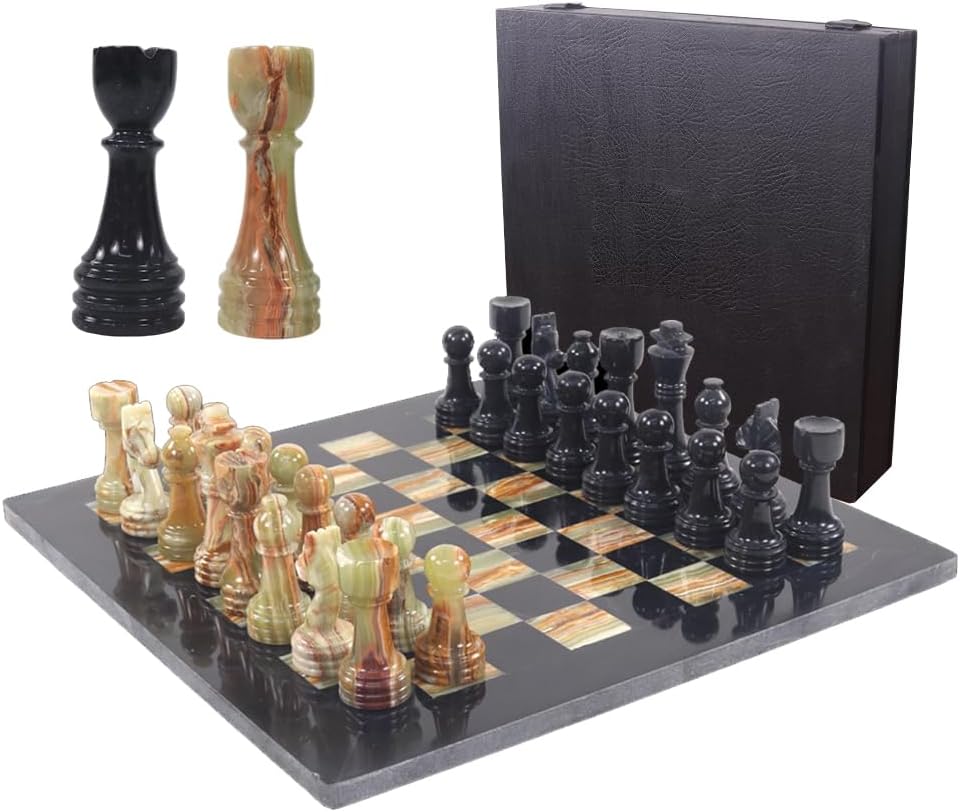
Green onyx is one of the few chess set materials that can genuinely stop a visitor in their tracks. Because it is a softer, more brittle stone than dense white marble, green onyx pieces benefit from careful handling. The Knights and Bishops in particular — with their thinner carved sections — should be treated gently. The reward is a display piece of exceptional natural beauty.
4.3 Red & Dark Brown Marble
|
|
Red & Dark Brown Marble Origin: Red marble: Rosso Verona (Italy), Rojo Alicante (Spain), Red Rajasthan (India). Dark brown / fossil: Morocco, Tunisia. |
|
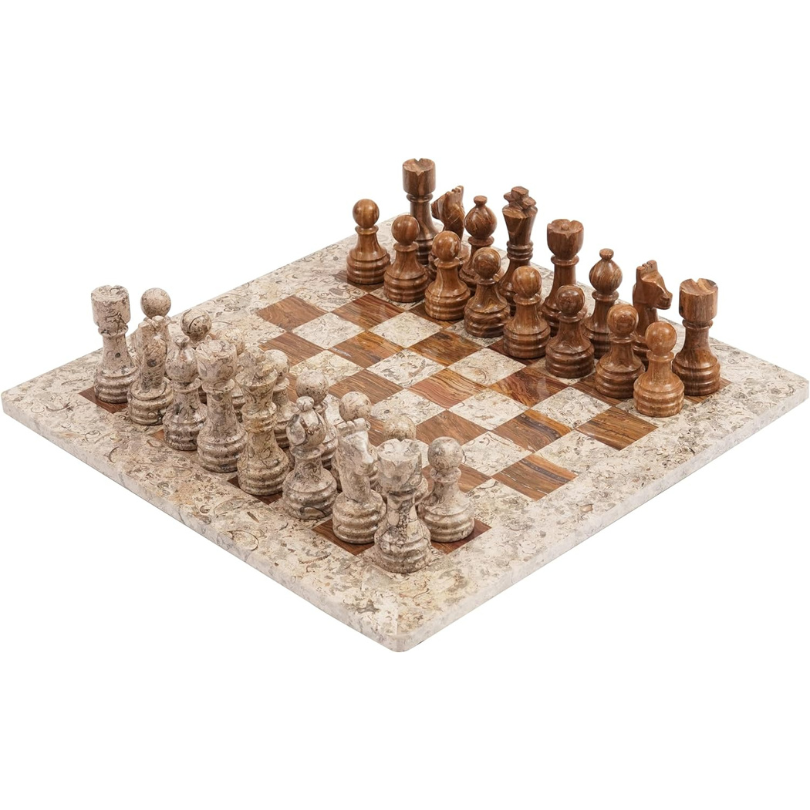
How it looks: Red marble ranges from a rich burgundy-red with white veining to a deeper terra-cotta with cream swirls. Dark brown fossil marble — sometimes called "fossil stone" — features actual embedded fossilised shells and marine organisms in earthy chocolate-brown or dark grey stone, creating a natural mosaic effect unlike any manufactured material. Pairs with: Dark wood furniture (mahogany, ebony, dark walnut), leather chairs, traditional and club-style interiors. Best for: Those seeking warmth and drama; gifting for wine connoisseurs or lovers of classic, rich interiors; executive desk display. Mood: Rich, warm, authoritative. Red marble brings fire; fossil stone brings the ancient and extraordinary. |
|
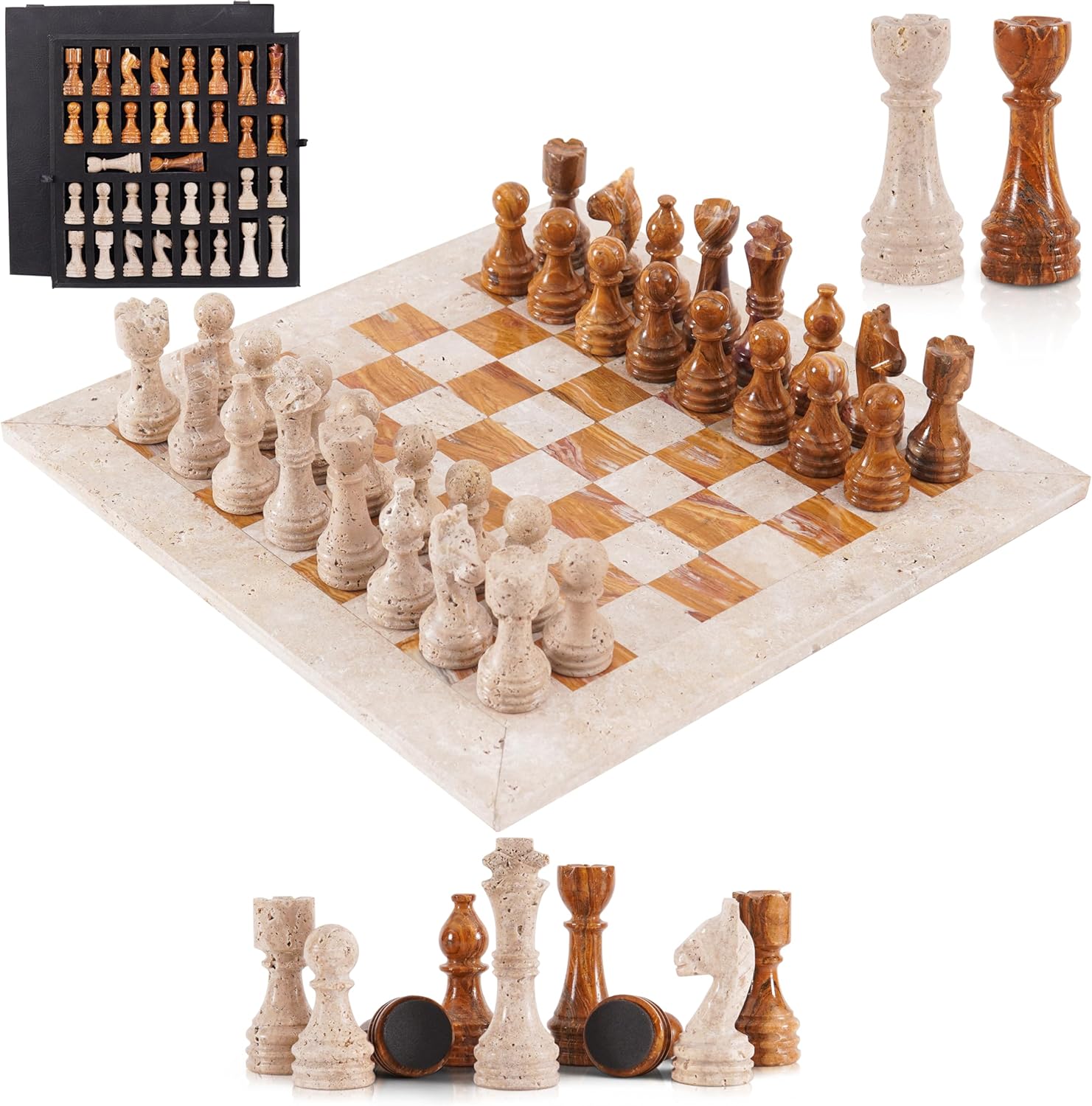
Fossil stone deserves special mention. Unlike any other chess set material, each board square tells a millions-of-years-old story — the fossilised outlines of ammonites, bivalves, and coral polyps visible in every piece and square. If conversation-starting is a goal, fossil marble is unbeatable. Be aware that the porous nature of fossil stone means it benefits from periodic sealing with a stone-safe impregnator.
4.4 Coral / Pink Marble
|
|
Coral & Pink Marble Origin: Pink marble: Rosa Portogallo (Portugal), Persian Pink (Iran), Rose Aurora (France). Coral onyx: Mexico, Pakistan. |
|
How it looks: Coral marble has a warm, rosy-pink base with white or cream veining. It is softer in tone than red marble — more blush than fire. Coral onyx leans slightly more orange-peach, with banded patterns in rose, peach, and cream. Both have a distinctly feminine, warm warmth. Pairs with: Cream or white furnishings, gold hardware, blush and nude interior palettes, modern Hamptons or Mediterranean styles. Best for: Contemporary interior spaces; gifting for design-forward recipients; adding warmth to a light, neutral room. Mood: Warm, inviting, modern-romantic. A refreshing alternative to the more serious black and white combination. |
|
Coral and pink marble sets have seen growing popularity over recent years as interior design has shifted toward warmer, more textural palettes. Often paired with black marble for high contrast, or with white marble for a soft, tonal look, these sets work particularly well in living rooms and bedrooms where a warmer atmosphere is desired.
4.5 Travertine
|
|
Travertine Origin: Iran (Persian Travertine), Italy (Tivoli/Classic Travertine), Turkey. |
|
How it looks: Travertine has an immediately recognisable earthy, textured look with a pitted, honeycombed surface that is unlike polished marble. Colours range from pale ivory and light cream to warm honey-gold and even slightly rusty sienna. The natural pitting creates depth and shadow, giving boards and pieces an almost archaeological, antiqued quality. Pairs with: Mediterranean interiors, terracotta tiles, natural linen fabrics, rustic timber furniture, neutral and earthy colour palettes. Best for: Buyers who prefer an organic, natural, understated look; Mediterranean or Tuscan-inspired interior styles; display in dining rooms or kitchens. Mood: Natural, earthy, artisanal. Like a sun-warmed Italian piazza in miniature form. |
|
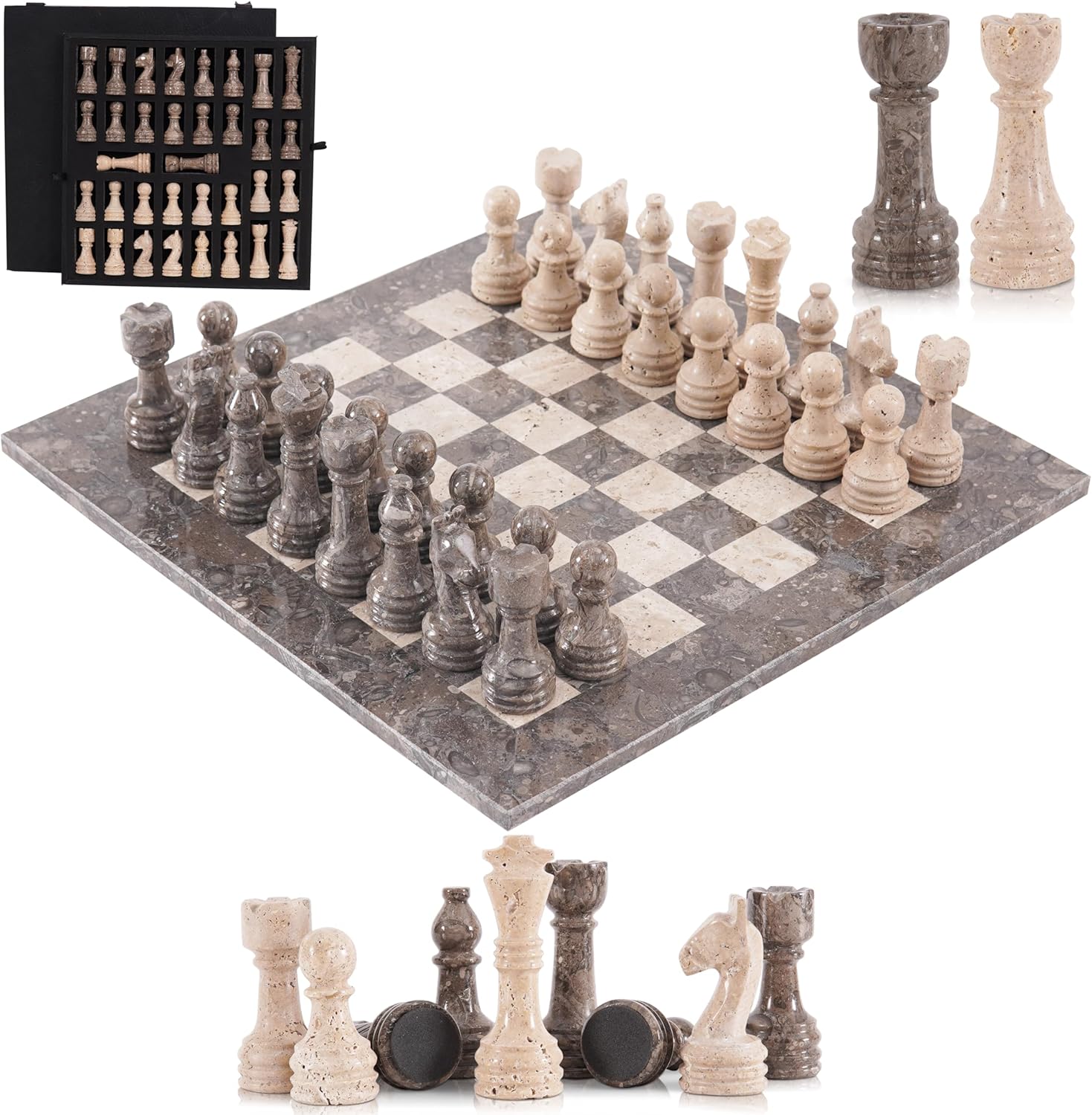
Travertine is lighter in weight than dense marble and its pitted surface means it does not achieve the same mirror polish as marble or onyx. Many buyers find this a feature rather than a flaw — the matte, textured finish has an honesty and naturalness that highly polished stone cannot match. Travertine boards are often filled (grouted) to create a smooth playing surface, while the pieces may retain visible pitting as a design element.
4.6 Oceanic (Blue & Teal Turquoise Stone)
|
|
Oceanic / Turquoise Stone Origin: Howlite and dyed turquoise-style stone: Mexico, China. Natural blue agate and sodalite: Brazil, Namibia. |
|
How it looks: Oceanic sets typically use dyed white howlite (a chalk-white borate mineral that accepts dye beautifully) or similar stones treated to achieve vivid turquoise and ocean-blue hues with natural veining. The result is a striking teal-to-cobalt palette with white and darker blue veining that evokes ocean waves, glacial ice, or Moroccan tilework. Pairs with: Coastal and beach-house interiors, white-painted rooms, rattan furniture, blue and white colour schemes. Best for: Coastal home décor enthusiasts; beach house or holiday home displays; gifts for ocean lovers or travellers. Mood: Cool, refreshing, coastal. Evokes the sea and sky in physical form. |
|

A note on material honesty: many "oceanic" sets are made from dyed stone, not a naturally occurring blue marble (which, while available, is extremely rare and costly). Dyed howlite is a legitimate and attractive material, but you should be aware that prolonged exposure to strong sunlight can fade the colour over time. Keep oceanic sets away from south-facing windows or use UV-filtering glass if displaying in a sunny room.
4.7 Verona Red / Rosso Verona
|
|
Verona Red (Rosso Verona) Origin: Veronese hills of the Veneto region, northern Italy; also quarried in Spain (Rojo Alicante) and Iran. |
|
How it looks: Rosso Verona is an Italian red limestone-marble with a distinctive deep red to burgundy-red base and prominent white, cream, or grey fossil inclusions. It is less uniformly red than Spanish red marble — the scattered fossil fragments give it a distinctive, almost painterly quality. High-quality Verona stone has a mirror polish that makes the reds appear to glow from within. Pairs with: Classic European interior styles, dark timber furniture, brass and gold metalwork, leather-bound book collections. Best for: Collectors seeking a premium Italian stone; formal studies and gentlemen's club aesthetics; gifts for architecture or design professionals. Mood: Grand, baroque, Italian luxury. Unmistakably European in character — the marble of Roman palaces. |
|
Rosso Verona has been used in Italian architecture and decorative arts for centuries — it lines the floors and walls of palaces, cathedrals, and piazzas across Northern Italy. A chess set in Verona marble brings that same legacy of Italian craftsmanship into the home. Note that "Verona" as a colour name is used by some retailers to describe sets made from other red stones (including Spanish or Indian red marble) that achieve a similar look; genuine Italian Verona marble is more expensive.
5. Choosing the Right Size
Marble chess sets are typically sold in three standard board sizes, measured by the length of one side of the board. Here is how to match size to your intended use.
|
Size |
Dimensions |
Best Suited For |
Typical Weight |
|
10 inch |
25 cm × 25 cm |
Gifting, desk or shelf display, apartments with limited space |
1.5–2.5 kg |
|
12 inch |
30 cm × 30 cm |
Coffee table display, regular casual play, most common all-rounder size |
2.5–4 kg |
|
15 inch |
38 cm × 38 cm |
Statement display piece, large tables, serious collectors |
4–8 kg |
The 12-inch (30 cm) set is the most popular choice for most buyers. It is large enough to make a visual impact, light enough to move comfortably, and fits on most standard coffee tables and side tables without dominating the space. If you are purchasing as a gift and are unsure of the recipient's space, a 12-inch set is a safe and satisfying choice.
The 15-inch set is genuinely imposing — these are the sets that define a room. They require a dedicated, stable surface and are heavy enough that moving them requires care. The reward is extraordinary visual presence.
The 10-inch set makes an excellent desk piece, travel gift, or introductory set. At this scale, the pieces are smaller and more delicate, so handle with corresponding care.
6. What to Look For When Buying
6.1 Piece Design
Most marble chess sets use a simplified Staunton-inspired design — the universally recognised style with a King cross, Queen crown, Bishop mitre, Horse-head Knight, Castle Rook, and cylindrical Pawn. Because marble cannot achieve the fine undercut detail possible in wood, marble Staunton designs are somewhat simplified, but the best craftsmen maintain clear visual distinction between all six piece types.
The Knight is always the hardest piece to execute well in stone. Examine the Knight's head carefully in any set you are considering: a well-carved marble Knight will have a recognisable horse profile even if simplified, clearly defined ears, and a clean neck. A poorly executed Knight looks like an indistinct lump — the surest sign of low-quality craftsmanship throughout the set.
6.2 Board Quality
• Flatness — run your finger across the seams between squares. They should be flush. Any step or ridge indicates poor finishing and will cause pieces to tip during play.
• Seam quality — the adhesive lines between squares should be thin, even, and ideally colour-matched to the adjacent stone.
• Polish consistency — the board surface should have a uniform sheen across all squares of the same colour.
• Underside — quality boards have a felt or rubber base to protect the surface they rest on, and to prevent the board from sliding.
6.3 Storage and Packaging
Marble pieces chip, scratch, and crack if knocked against each other. A quality set should come with a storage solution — either a wooden box with individual foam inserts, a velvet-lined case, or individual bags for each piece. Sets that arrive loose in a single box without padding are both difficult to store safely and more likely to arrive damaged.
6.4 Price Expectations
As a general guide: expect to pay USD 30–80 for an entry-level machine-made 10–12 inch set; USD 80–200 for a good quality 12-inch set with proper piece finishing and storage box; USD 200–500 for a premium 15-inch set with exceptional stone quality and artisan finishing; and USD 500+ for collector-grade sets using premium Italian or rare stone.
|
Red Flags When Shopping Online • No close-up photograph of the Knight piece — likely hiding poor carving quality. • "Marble" in the product name but "composite stone" or "resin" in the description — this is not natural marble. • All piece photos taken on white backgrounds with heavy post-processing — colours and veining may look very different in person. • No mention of storage or packaging — pieces will likely arrive loose. • Price under $25 USD for a 15-inch set — this is physically impossible with natural stone; likely reconstituted stone or misleading photography. |
7. Care and Maintenance
Marble and stone chess sets are durable but not indestructible. Follow these guidelines to keep your set looking its best for generations.
Cleaning
• Wipe pieces with a soft, slightly damp cloth. Avoid abrasive cloths or scrubbing pads.
• Use only pH-neutral stone cleaners or a diluted dish soap solution. Acidic cleaners (vinegar, citrus) will etch marble surfaces permanently.
• Dry immediately after cleaning — prolonged moisture can stain lighter stones.
• Never submerge pieces in water.
Polishing
• High-gloss sets can be refreshed with a small amount of marble polish or carnuba wax applied with a soft cloth.
• Matte-finish sets — particularly travertine — should not be polished; doing so alters their intended look.
• For onyx sets, a light application of mineral oil every few months will enhance the depth of colour and protect against minor scratches.
Storage
• Always store pieces in their box or bags. Never leave them loose where pieces can knock together — the edges of bases and tips of pieces chip most easily.
• Keep the set out of direct sunlight if possible; UV exposure does not harm marble but can fade dyed stones (oceanic sets) over time.
• In humid climates, a silica gel sachet in the storage box will prevent moisture build-up.
Handling Accidents
• If a piece chips slightly, a jeweller's epoxy in a matching colour can be used for repairs — many craftsmen in Indian workshops will supply repair kits on request.
• A cracked piece should be repaired promptly; if left, temperature changes can cause the crack to propagate.
• If a piece breaks completely, contact the manufacturer — most reputable suppliers can provide replacement single pieces from the same stone batch.
8. Your Pre-Purchase Checklist
|
Before You Buy: Quick Checklist • Decided on colour combination based on my interior style. • Chosen the right size (10", 12", or 15") for the space and use. • Confirmed whether stone is natural or composite/reconstituted. • Examined close-up photos of the Knight piece for carving quality. • Verified that the set includes a storage box or piece bags. • Read seller reviews specifically for stone quality and colour accuracy. • Checked the return policy in case of colour difference from photographs. • Confirmed delivery packaging — fragile items should ship in foam-lined boxes. |
This guide was produced for chessnboards.com. All stone descriptions reflect natural material characteristics; individual sets will vary.

Leave a comment